Qmark Baseboard Heaters
Qmark Baseboard HeatersQmark Baseboard HeatersQmark Baseboard HeatersQmark Baseboard HeatersQmark Baseboard HeatersQmark Baseboard HeatersQmark Baseboard Heaters

Qmark Baseboard Heaters

Flat Rate Shipping On Most Heaters and Fans

Qmark Baseboard Heaters

Buy Online At

Qmark Baseboard Heater Information

Learn How To Install A Baseboard Heater

Calculate Operating Costs

Why Buy Qmark Baseboard Heaters ?
Qmark, Berko, Marley Baseboard Heater

 952kb WAV File -  Windows Media Player Will Open To Play It

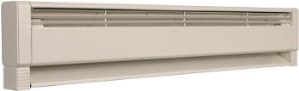
Baseboard heating systems are set up so that each baseboard is responsible for heating a particular room or area. Each unit is controlled by a thermostat, which can be located on the wall or on the unit itself.

There are two basic components of a baseboard heating system: the element and the thermostat. The element produces heat when electricity passes through it. Each element contains a series of metal plates called fins, which help send heat to a broader area. The thermostat simply tells the element when to activate and for how long.

How does it work? Cold air is drawn over the heated fins from the bottom of the baseboard and directed into the room by a deflector hood. The heated air rises and forces the cold air to the floor, and the process repeats itself.

Tips for operating and maintaining a baseboard heating system:

  • Turn down the thermostat in rooms that aren't being used.
  • Set thermostats to temperatures at the low end of the comfort range. This prevents excessive cooling at night or when no one is home.
  • Baseboards take a while to heat a room compared to fan-assisted heaters, so plan ahead for maximum efficiency.
  • Follow the heating unit's maintenance instructions.
  • Never open the baseboard cover without turning the heater off at the breaker panel and letting the heating element cool.
  • Keep the area around the heating units free from obstructions to allow proper air flow. Place furniture at least six inches from baseboard heaters. Keep drapes from touching heaters. Fire danger from baseboard heaters is low, but avoid allowing any objects to come in contact with them.
  • Don't place combustible materials on or near heaters.
  • Vacuum baseboards occasionally to remove dust and other debris. This is particularly helpful at the end of the summer, when the most dust collects. Vacuuming will reduce the "burned dust" smell you get from baseboard heaters when they're turned on for the first time in months.
  • If there are multiple heaters in one room control them from one centrally located thermostat.

The room by room heating alternative - Keep cozy anywhere, anytime

Baseboard heaters are the ideal room-by-room heating solution. They require little space, no ductwork and the initial cost is relatively low, making them perfect for remodeled areas as well as for new construction. Units are easily installed in almost any kind of space plus, baseboard units heat each room separately, which may result in reduced energy consumption when unused rooms are not heated. Baseboard heating is quiet, draft free and each room can be thermostatically controlled. Temperature will be maintained to within one or two degrees of the thermostat setting.l

Qmark Baseboard Heaters

In applications such as apartments or retirement homes, the independent units allow each resident to select the room temperature they prefer.

Simple, low-maintenance operation - Baseboard heaters have a central heating core that simply heats the cooler air at floor level and allows the lighter, warmed air to move upward into the room. Since there are no moving parts, baseboard heaters are essentially maintenance free.

Safe for all concerned - Safety features include a built-in thermal cutoff which shuts off the heater in the event of overheating, then automatically reactivates the heater when the temperature returns to normal. Baseboard heaters are UL approved.

Options from the inside out - The basic baseboard heater is a convector model. Its heating element is suspended inside the unit to eliminate expansion and contraction noises. Hydronic baseboard heaters have a heating element which is immersed in a heat-transfer fluid sealed inside a copper tube. The nonflammable fluid continues to radiate warmth after the unit cycles off providing a more consistent temperature.

Baseboard heating units are designed for various BTU, wattage and voltage requirements. Features include wall or unit mounted thermostats and companion controls for air conditioning.

Supplementary heating - Baseboard heaters are the ideal supplement to the central heating system if you want to keep one room slightly warmer than the others. They are often used in room additions. Because they come in varying lengths, they lend themselves for use in odd-shaped rooms.

Comfort to fit your decorating plan - Today's baseboard heaters come in neutral colors to blend with any environment or can be repainted to match any room. Their low operating temperatures prevent any wall discoloration. Units range from three to ten feet in length and extend only about 3" from the wall. They may be mounted over any floor covering, including carpet.

Next Page - More Qmark Baseboard Heater Information

Buy Online At

Learn How To Install A Baseboard Heater

Qmark Catalog

Find What You Need ?

Enter A Product Name Or Description To Search

   Search this site                 powered by FreeFind
 

Can't Determine What You Need ? Ask Us !!

F.N. Cuthbert Inc.     3151 South Ave.     Toledo, OH 43609
800 - 472 - 3292     419 - 385 - 0881     Fax: 419 - 385 - 3716

E-Mail: sales@fncuthbert.com